
Although reports of the ‘problematic’ algal bloom in the northern Adriatic began circulating back in May, the truth is that this phenomenon only started in early June.
What’s important to note is that it now appears throughout the Adriatic and not only near the river Po delta. This time it has also emerged in less expected areas, such as the coastal waters around Split.
Today, we’re sharing the results of a study in which we detected and documented the presence of mucilage, the organic aggregates that form as a result of an abnormal algal bloom.
But there’s no need for alarm, as this is not considered pollution (according to the EU’s Marine Strategy Framework Directive). Since the phenomenon is currently limited to a relatively small area compared to the entire Croatian coastline, no reputational risk is expected for the Croatian tourism.
Still, we should remain alert, as abnormal algal blooms can have a range of negative effects on the marine environment.
The footage below shows the wider area around Split, along with close-up frames from our analysis clearly identifying mucilage clusters.
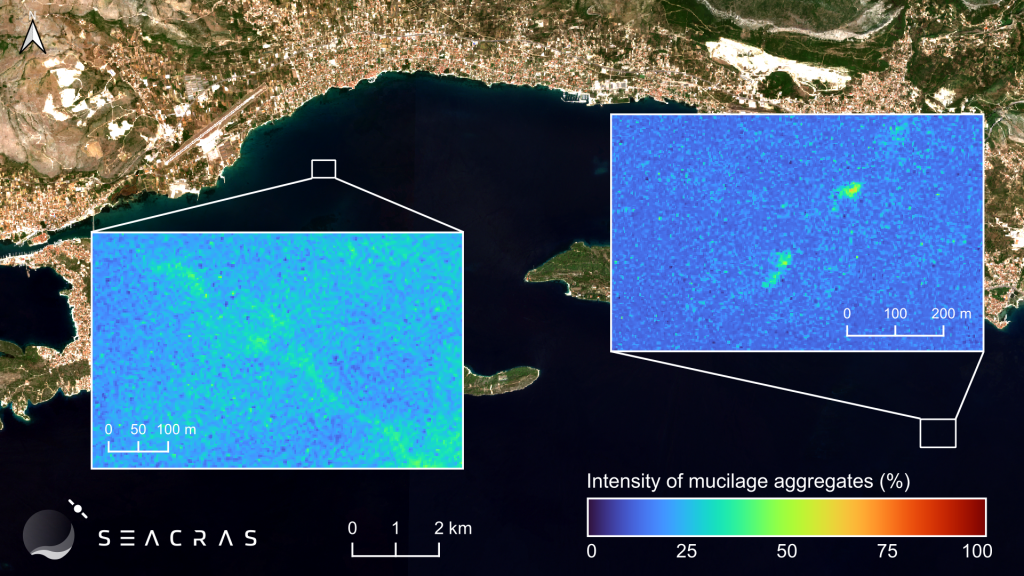
Algal bloom and mucilage clusters in coastal waters around Split
These are extremely small aggregates, invisible to conventional satellite imaging methods available through publicly available services like Copernicus or Landsat.
Quantifying mucilage concentrations and pinpointing their spatial distribution at a micro-level (as precise as 10-20 meters) was made possible through a combination of very-high-resolution satellite imagery and AI, a key component of SeaCras’ Coastal Intelligence system.
And this is where the importance of the Early Warning System (EWS) comes in. SeaCras uses this warning system to detect such phenomena in their early stages, before it’s too late.
But one key question remains:
Would you like to receive this kind of insight in real time?
Stay tuned. More updates are coming soon!