

Now in its fourth consecutive year, the study examines how familiar people in Croatia are with artificial intelligence and how they perceive, use and evaluate it.
The study was organised by SeaCras under the patronage of Algebra Bernays University. The research team comprises Professor Robert Kopal, PhD, Associate Professor Krešimir Žnidar, PhD, and Darija Korkut, PhD. Fieldwork was conducted by the research agency Prizma CPI.
This year’s study involved 2,452 respondents across two components: face-to-face household interviews with a sample of 1,450 respondents and an online survey with a sample of 1,002 respondents. The findings presented here are based on weighted online survey data, aligned with the reference face-to-face survey and demographic data from the 2021 Census.
Familiarity with artificial intelligence is growing
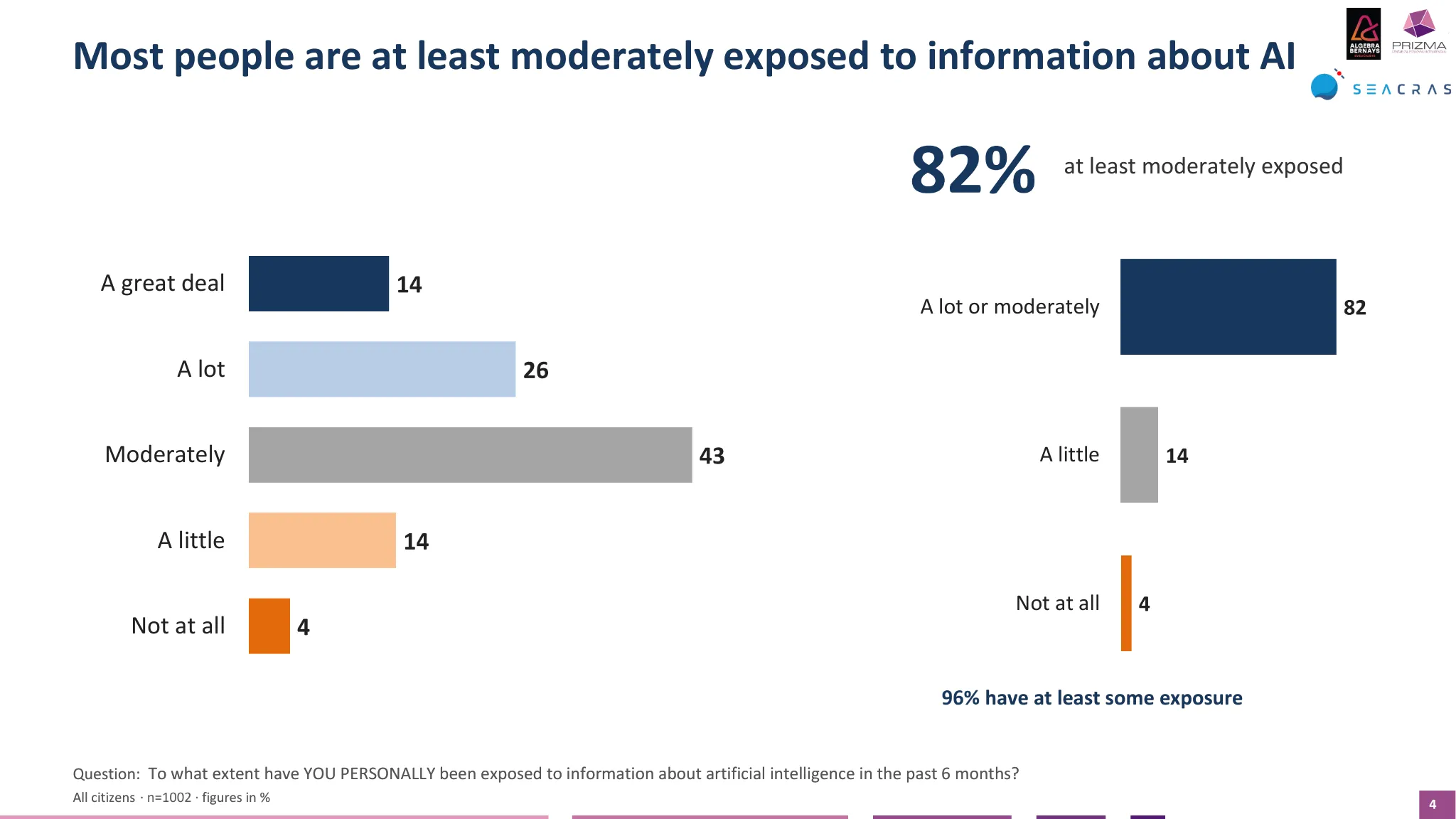
The proportion of people who rate their knowledge of artificial intelligence as good has risen from 21% in 2023 to 45% in 2026. Over the past six months, 82% of people have been at least moderately exposed to information about AI, and 96% have had at least some exposure.
The average AI literacy index score, based on self-assessed familiarity with AI terminology, is 53 out of a possible 100 points. Under the study’s classification, 32% of people have a high level of AI literacy, 57% a medium level and 10% a low level.
51% of people report positive associations with AI, while 44% report negative ones. Overall, 41% have a positive attitude towards artificial intelligence, 38% a neutral attitude and 21% a negative attitude. The most common individual association is usefulness, selected by 48% of people.
AI tools are most often used to find information and translate text
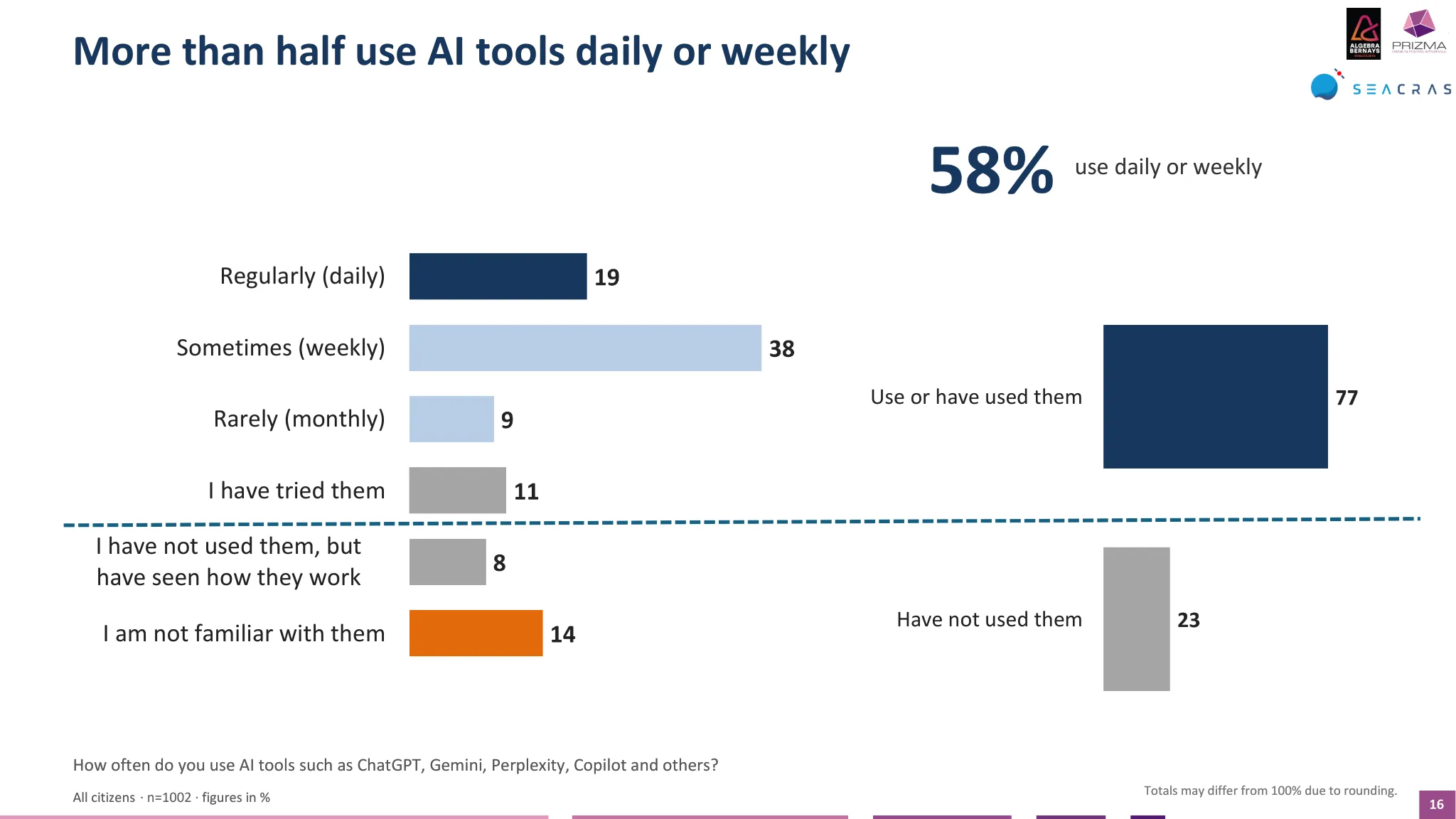
AI tools such as ChatGPT, Gemini, Perplexity and Copilot are used daily or weekly by 58% of people. In total, 77% use them or have at least tried them.
Personal use predominates within this group: 63% report using the tools solely for personal purposes, 31% for both personal and professional purposes, and 6% solely for professional purposes. Among those who use or have tried AI tools, 82% say they have used them to gather information and 71% to translate text.
Medical advice is the third most frequently reported use, cited by 67% of the same group. 58% report using the tools for advice on nutrition, exercise and healthier living, and 27% for mental health advice. These figures describe respondents’ experience of using AI tools for these purposes; this survey question does not establish whether that use replaced professional healthcare.
Trust depends on the area of application
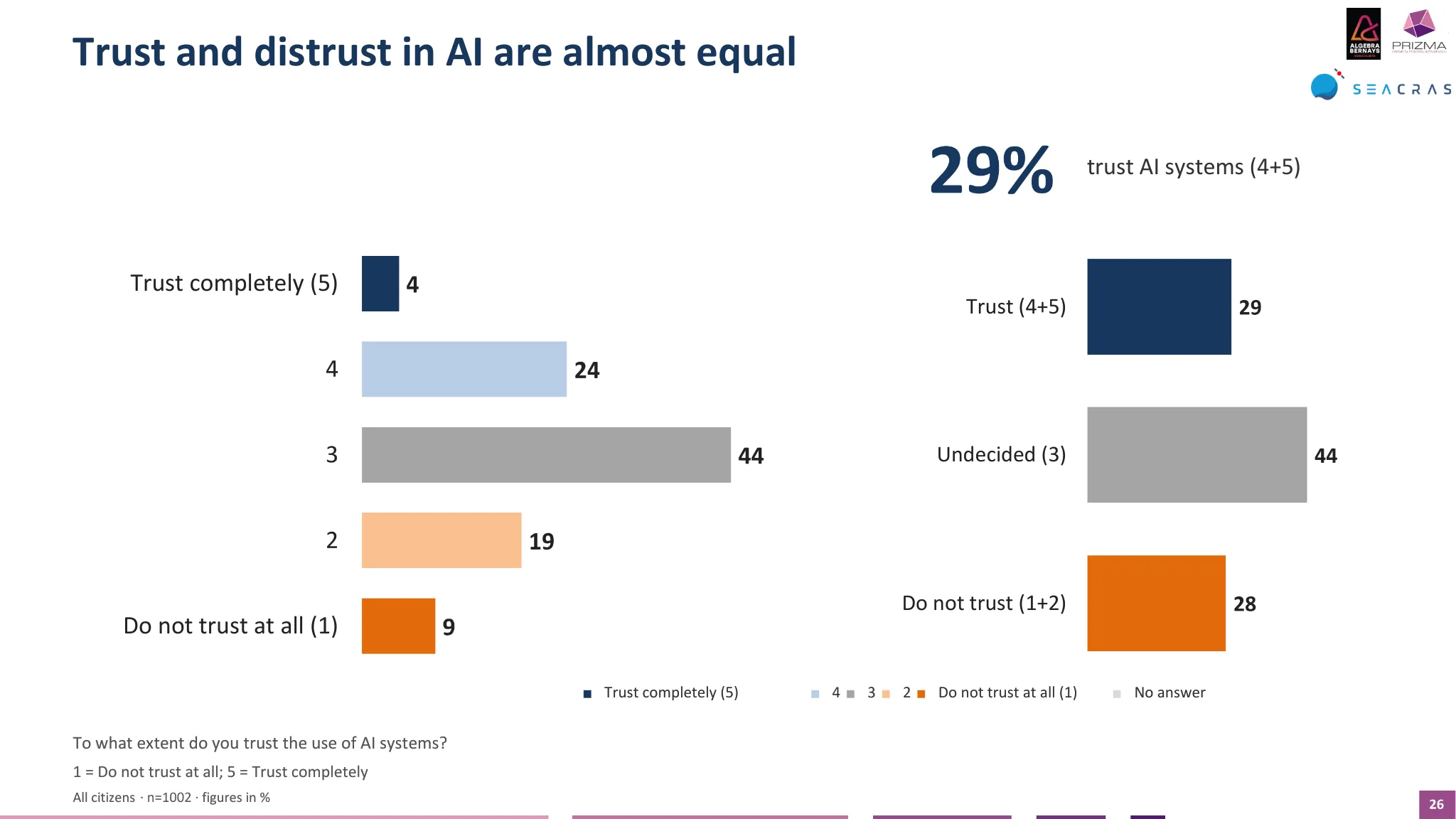
29% of people trust the use of AI systems, while 28% do not. The largest group, 44%, selects the midpoint of the scale. Of the areas examined, the use of AI in education attracts the greatest trust, at 40%, followed by healthcare at 34%.
The acceptability of AI advice also varies by area. Advice on computers and information technology is acceptable to 53% of people, travel planning to 51%, legal matters to 47%, finance and investments to 37%, and health to 36%. Psychological counselling is acceptable to 26% of people.
Acceptance is lower for some public applications: 37% of people find the use of AI in government and public services acceptable, 30% in autonomous vehicles on public roads, and 24% in decision-making in court cases and administrative disputes.
People are cautious about delegating tasks
Half of the public find it acceptable for an AI tool to find and compare information on their behalf. Scheduling an appointment or meeting is acceptable to 34%, and completing an administrative form to 32%.
Acceptance is lower when the task involves handling money. 29% of people find it acceptable for AI to make a purchase with their confirmation, 11% to make a purchase without further confirmation, and 10% to manage their personal finances. The difference between purchases with and without confirmation points to the importance of users retaining control over AI’s actions.
Privacy and social consequences raise concerns
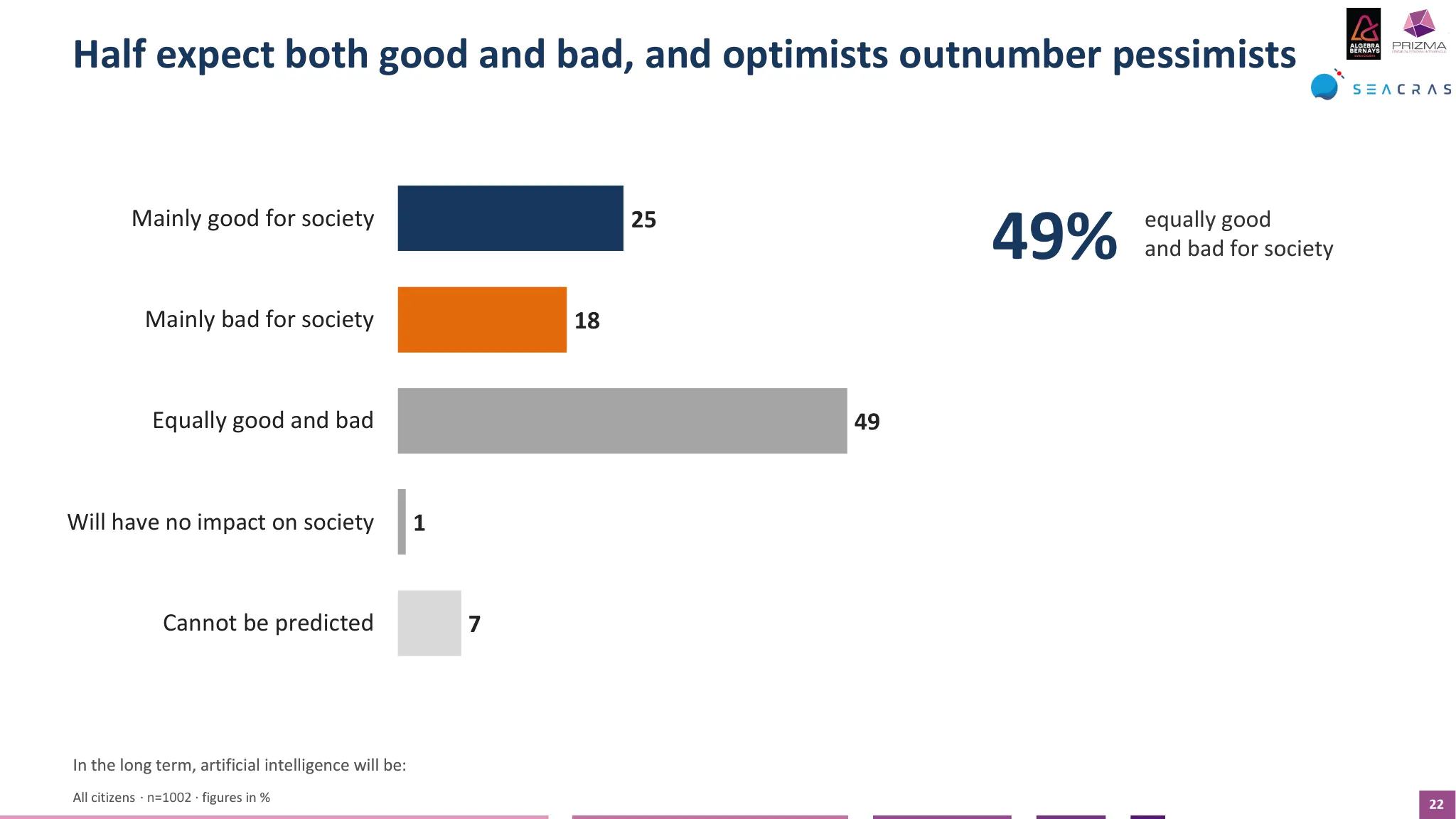
Almost half of people, 49%, expect AI to be equally good and bad for society in the long term. 25% expect a mainly positive impact, and 18% a mainly negative one.
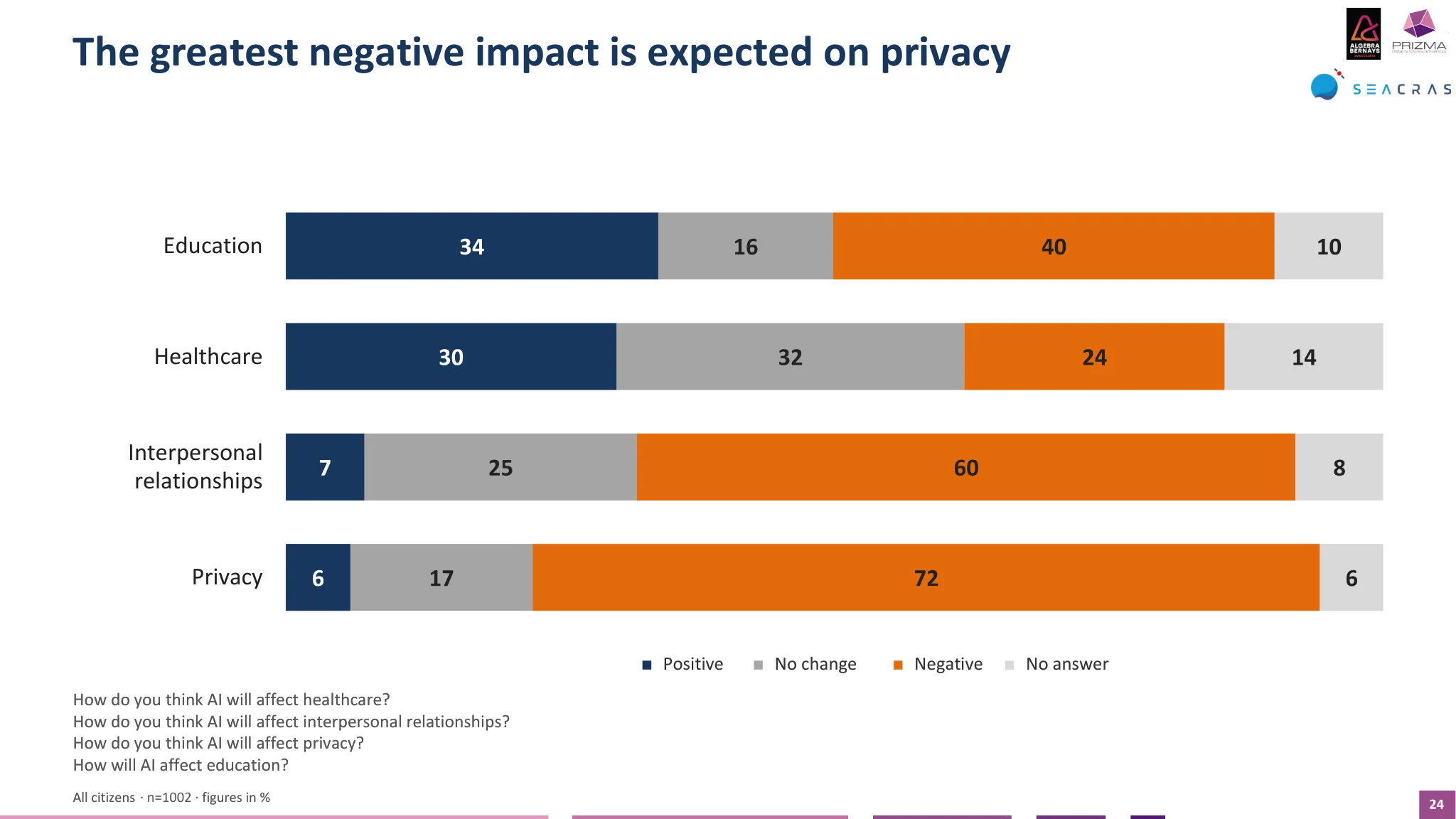
72% of people expect a negative impact on privacy, and 60% on interpersonal relationships. In education, 40% expect a negative impact and 34% a positive one. Healthcare is the only one of the four areas examined in which positive expectations outweigh negative ones, at 30% and 24% respectively.
65% of people express concern about AI’s potential influence on public opinion through fake news, disinformation and manipulation. A total of 56% are concerned that they will be unable to distinguish content created by artificial intelligence from content created by humans.
In relation to employment, 47% of people expect AI to cause the loss of many jobs in Croatia over the next five to ten years. 27% expect no change, while 10% expect more jobs to be created. These findings reflect people’s expectations and concerns.
Expectations for education remain mixed
Although 42% of people expect AI to make it easier for pupils and students to complete their education, reservations remain about other potential effects. 50% expect a negative impact on creativity, 45% on the quality of knowledge acquired, and 51% on pupils’ and students’ mental health.
These findings show that expectations about making education easier to complete differ from expectations about the quality of the educational experience and the wellbeing of pupils and students.
AI use at work needs clear rules
Among employed and self-employed people, 56% report using AI at work. This figure also includes those who use AI for personal assistance rather than for official work tasks.
Among those who use AI at work, 62% say that their organisation has no rules or guidance on its use. 14% report clear rules, while 15% say that guidance exists but is unclear. The findings suggest that organisations need to establish clearer rules for using AI tools and provide employees with guidance they can understand.
Working alongside people is the most common vision of the future
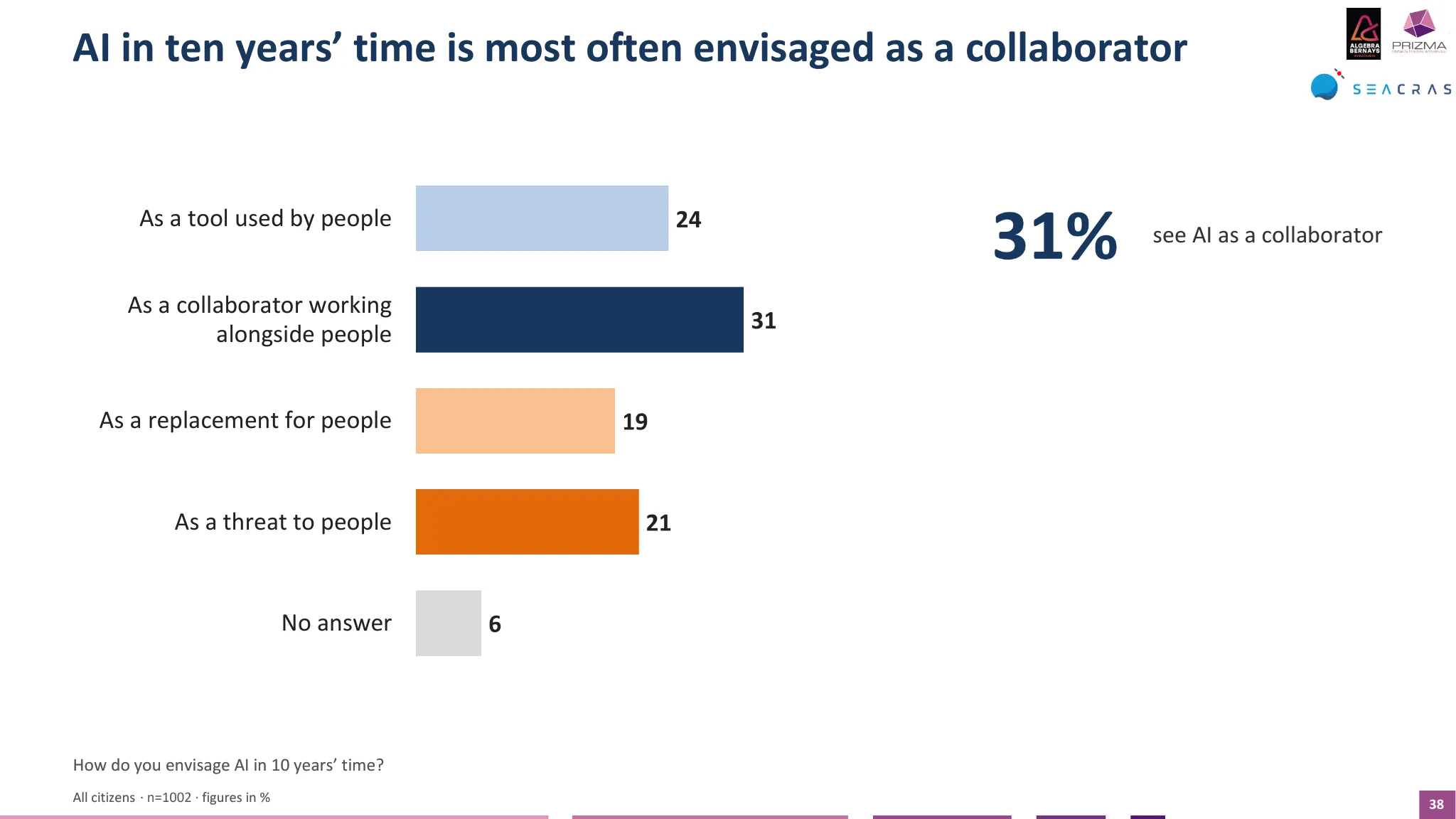
Looking ten years ahead, 31% of people imagine AI as a collaborator working alongside humans. It is seen as a tool by 24%, as a threat by 21% and as a replacement for humans by 19%. When asked to identify the single greatest benefit of artificial intelligence, respondents most often choose replacing humans in risky activities, an option selected by 20%.
The findings provide a basis for developing and introducing AI solutions that deliver practical benefits while taking account of users’ concerns, the need to protect privacy and the ability to control the tasks carried out by the technology.
An overview of the first part of the research findings and a description of the methodology are available in this PDF.
Percentages have been rounded, so totals across categories may differ from 100%.
Coming soon: an exclusive look at AI and satellite technology for protecting marine and inland waters
Would people trust a system that uses satellite imagery and artificial intelligence to monitor the quality of marine and inland waters and warn of potential pollution?
In the second release of the research findings, we will present responses from the “Marine and inland waters” section. We will reveal how concerned people are about the state of Croatia’s seas, rivers and lakes, how important access to up-to-date information about their quality is to them, and whether they would support using alerts from these technologies to prompt further checks and preventive action.
We will also show which applications people consider most useful and how attitudes differ across generations.
We will publish the second part of the research findings on our website soon.
About the research team and partners
Alongside SeaCras, several institutions and experts contributed to this study.
Algebra Bernays University, formed through the merger of Algebra and Edward Bernays University of Applied Sciences, is Croatia’s largest private university. It focuses on education and research in digital technologies, artificial intelligence, data science, economics and communications.
Professor Robert Kopal, PhD, Chief Science Officer at SeaCras and Head of the Creativity and Critical Thinking Institute at Algebra Bernays University, is an expert in artificial intelligence, data and security analytics, and strategic decision-making. He is the author of 15 books and more than 80 scientific and professional papers, with extensive experience across academia, business and government.
Associate Professor Krešimir Žnidar, PhD, a psychologist, researcher and founder of Prizma CPI, specialises in market and public opinion research, research methodology and data analysis. He has more than 25 years of experience in leading research projects and university teaching.
Darija Korkut, PhD, a professor at Algebra Bernays University and EFFECTUS University of Applied Sciences, is an expert in analytical methods, behavioural economics, creative and critical thinking, and strategic decision-making. She is the author of 11 books and has professional experience in diplomacy and the security and intelligence sector.
Prizma CPI is an independent Croatian agency specialising in market and public opinion research. For more than 25 years, it has conducted quantitative and qualitative business and social research, providing organisations with analytical insights to support decisions based on data.