
In the age of digital transformation and climate urgency, the maritime sector stands at a crossroads. Are “smart” and “green” ports two sides of the same coin – or competing paradigms? The answer, as emerging global trends suggest, lies in their complementarity.
From Smart to Sustainable
Smart ports use digital technologies, automation, and analytics to improve efficiency, safety, and logistics.
Green ports focus on environmental sustainability, reducing emissions, using renewable energy sources, and ensuring environmentally friendly operations.
Set theory question: is a green port a subset of a smart port?
Traditionally, these concepts evolved separately. Smart ports focused on optimisation, green ports on preservation.
But today’s leading maritime hubs — from Rotterdam and Singapore to Hamburg, Los Angeles, Miami, and Osaka — show that technology and ecology can reinforce each other rather than compete.

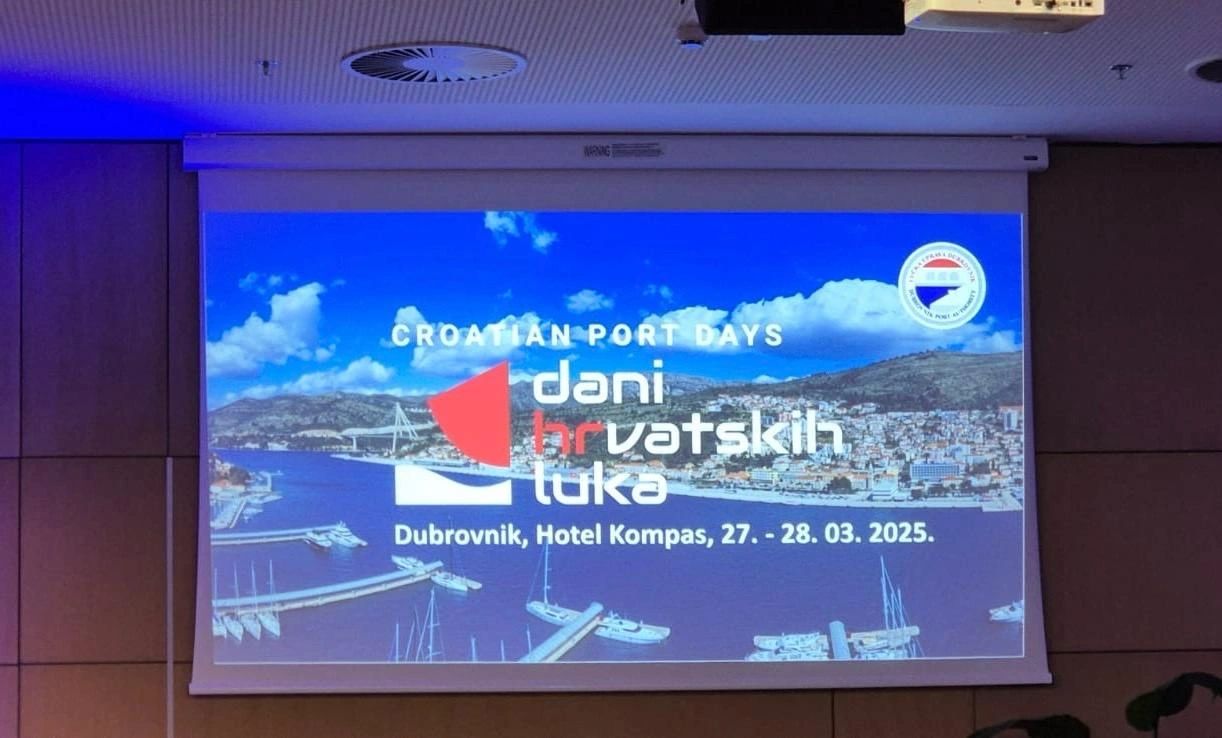
SeaCras’ CEO, Mario Špadina, held this lecture at the Croatian Port Days conference in Dubrovnik, March 27-28, 2025
The Convergence: When Data Meets Decarbonisation
The convergence of smart and green principles is redefining how ports operate.
Digitalisation enables precise energy management, predictive maintenance, and emissions tracking. Automation reduces idle times and fuel consumption. Data analytics and digital twins provide real-time insights that help optimise vessel movements, cargo handling, and infrastructure use — all while reducing the carbon footprint.
In practice, digital twins represent the next frontier, or they did 5 years ago. Now these should be benchmark already, if for nothing, then for derisking operations of port areas. These virtual replicas of port systems integrate all available data — from IoT sensors to physics-based simulations — creating a unified digital ecosystem. By mirroring real-world conditions, digital twins support decision-making, improve asset management, and align operational performance with sustainability goals.
“The modern trend is the convergence of smart and green principles, where technology enables sustainable port operations — creating efficient and environmentally responsible maritime hubs.”
(Source: Critical Success Factors for Green Port Transformation Using Digital Technology, JMSE, 2024)
Navigating the Digital Seas: Cybersecurity as Sustainability
However, this digital-green synergy comes with new challenges. The more connected a port becomes, the more vulnerable it is to cyber-attacks. Ransomware, supply chain vulnerabilities, and geopolitical risks represent tangible threats, with potential economic losses exceeding hundreds of millions of dollars.
As the maritime sector accelerates its digital shift, cyber resilience becomes part of environmental responsibility. Protecting digital infrastructure means safeguarding operational continuity — and by extension, reducing the environmental costs of disruption.
Toward Ports of the Future
The port of the future will not be defined solely by its cranes or terminals, but by its data flows, carbon metrics, and resilience frameworks.
AI, automation, and sustainability will not exist in silos, but within an integrated strategy that aligns economic efficiency, security, and ecological balance.
In this sense, the question “Smart or Green?” becomes obsolete. The future belongs to ports that are both — simultaneously intelligent and sustainable.
Author: Mario Špadina, CEO at SeaCras