
Regenerative tourism and sustainable tourism, while closely related, have distinct approaches and goals.
Sustainable tourism focuses on minimising the negative impacts of tourism on the environment, society, and economy, so that tourism can continue without causing long-term damage.
In contrast, regenerative tourism goes beyond sustainability by actively seeking to restore and rejuvenate the environment and communities affected by tourism. It emphasises that tourism can have a positive impact on natural and social systems, acting as a catalyst to positive change.
Based on our continuous engagement in this field, SeaCras was featured in WAVE’s report as following the best practices regarding the implementation of regenerative tourism. We were also invited by the Fondation Prince Albert II de Monaco, FII Institute, and Red Sea Global to participate in a curated event at the Blue Economy and Finance Forum in Monaco, part of the 2025 UN Ocean Conference 3 — UNOC3.
Founded by Her Royal Highness Princess Reema Bandar Al-Saud, WAVE is Catmosphere Foundation’s Collective Action Platform dedicated to restoring oceans by 2050. Powered by the Future Investment Initiative (FII) Institute, and in partnership with the Ministry of Energy of the Kingdom of Saudi Arabia, WAVE makes efforts towards the ambitious but achievable goal of ocean regeneration within a human generation.
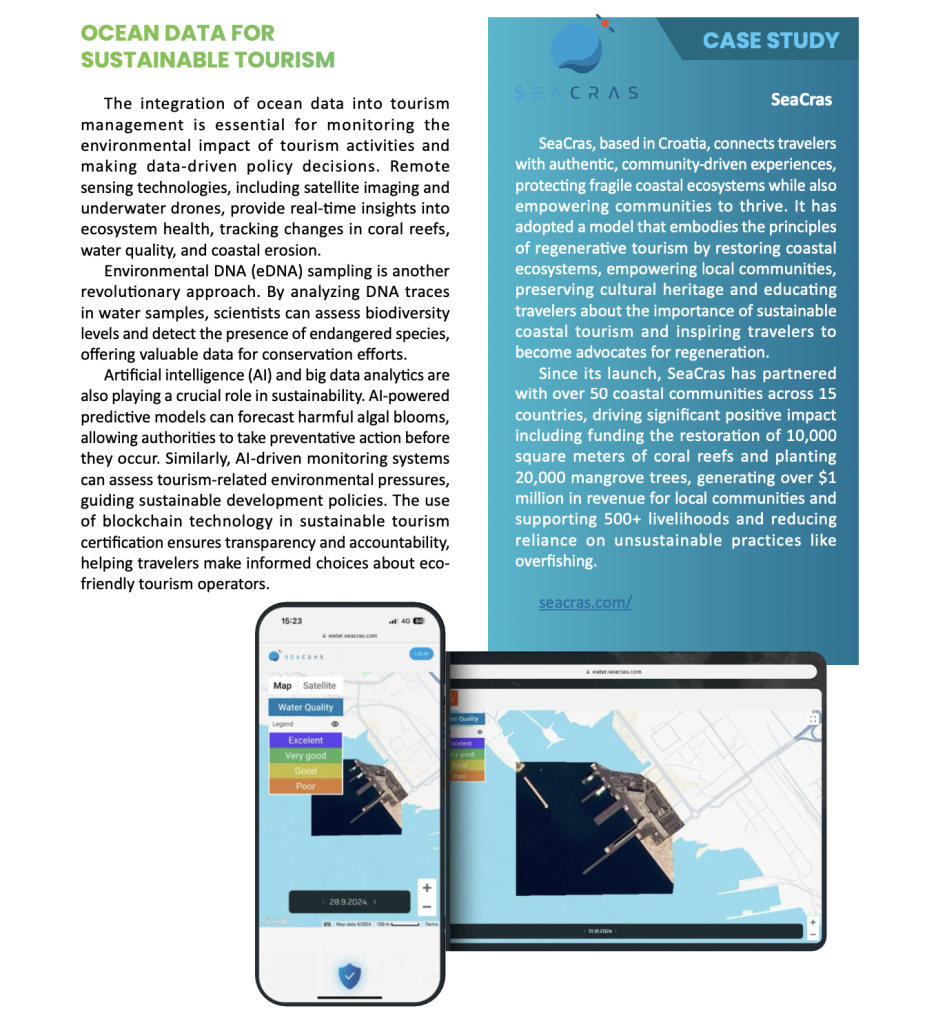
The same thing goes for our company. Since its launch, SeaCras has partnered with many coastal communities, NGOs, local and regional governments, and pioneers in regenerative tourism companies across two continents, driving significant positive impact. This includes funding the restoration of marine areas, and generating over $1 million in revenue for local communities.
Here are ways we’re helping shape regenerative tourism:
I. We’re part of the ‘Mission Restore Our Ocean and Waters’ Charter through our ‘We make the blue economy sustainable and transparent’ campaign, which leverages our AI-satellite technology to provide critical data and insights on sea health, while also monitoring and reporting pollution incidents throughout the world.
II. SeaCras is also working alongside Smeco AS on a bilateral project that represents an important step toward a more zero-emission cruising industry. Initiatives like this will play a key role in shaping responsible growth, with future efforts set to include large-scale studies across the Adriatic, Mediterranean, Caribbean, Red Sea, and other regions.
Some of the findings will be featured in the UN Ocean Prediction Atlas to help drive community engagement in conservation and restoration efforts, while also supporting open data and open science principles.
III. Specifically related to a project in Croatia, in partnership with Zadar Cruise Port, SeaCras is actively contributing to the preservation of the Velebit wilderness area, together with the NGO Rewilding Velebit. This includes engaging the local community through fully transparent data access, made easily available and free of charge via our SeaCras app.
IV. Moreover, at the International Institute for Climate Action (IICA) Impact & Connect After-Work Event, which focused on the theme ‘Resistance of the tourism sector to climate change’, our CEO, Mario Špadina, shared key insights on behalf of SeaCras.
He highlighted SeaCras’ approach to optimising ecological anchorages as an effective model for marine protection, the use of real-time data to calculate carrying capacity, and the development of the first global pollution monitoring system powered by AI and satellite imagery. He also emphasised the growing importance of embracing the concept of ‘regenerative tourism’.
With the declaration for marine restoration, signed by most UN countries, regenerative tourism becomes a key strategic plan for the long-term health of our ecosystems and communities. SeaCras thus also remains dedicated to promoting and implementing forward-thinking practices that ensure tourism not only sustains, but actively restores the environments we depend on.